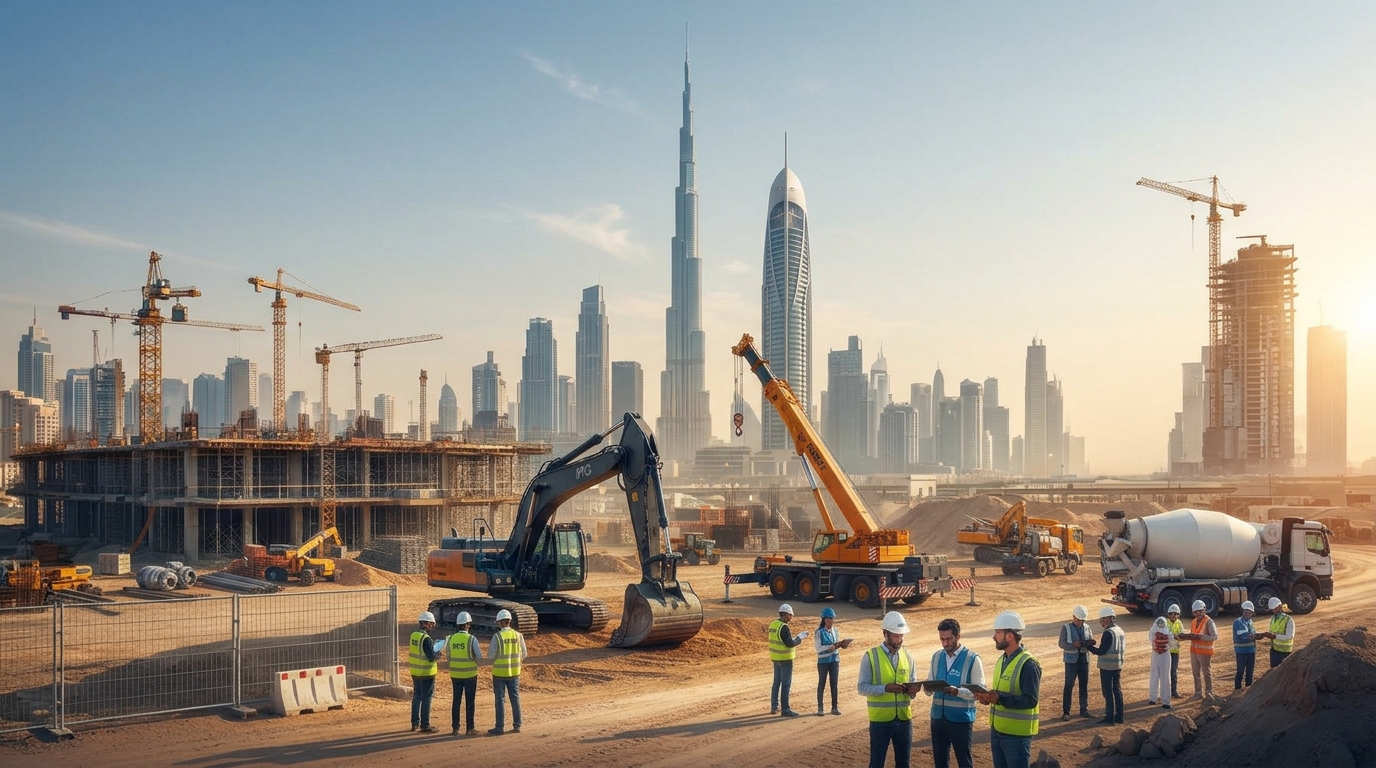
Frequently asked questions for Serbia investors on Dubai equipment and global markets
1. What is the Dubai Komatsu 40-ton excavator opportunity for investors from Serbia?
It is an equipment-backed investment opportunity in Dubai centred on a Komatsu 40-ton excavator with client contracts in place, an indicative reference value of AED 400,000 per machine, and choice of fixed monthly rental or net profit-sharing terms.
2. How does HPC assist investors from Serbia evaluating this Dubai opportunity?
HPC introduces qualified investors from Serbia, coordinates initial discussions, and helps align commercial terms and documentation prior to formalising an agreement.
3. How does the fixed monthly machine rental option work?
Under the fixed monthly rental option, the machine owner receives AED 7,000 per month while the operating company covers operator employment and site costs, insurance, Mulkiya, maintenance, repairs, wear parts, fuel, mobilisation, and client collections.
4. How does the net profit-sharing partnership option work?
Under the net profit-sharing option, the investor funds AED 400,000 per machine and covers agreed machine servicing, repairs, wear parts, annual insurance, Mulkiya, and operator visa, travel, insurance, and accommodation costs, while net profit is split 60% to the investor and 40% to the operating company.
5. How is net profit calculated under the profit-sharing option?
Using the illustrative monthly figures of AED 27,000 gross revenue and AED 20,000 net profit, the 60/40 split applies strictly to the AED 20,000 net profit (AED 12,000 to the investor and AED 8,000 to the operating company), with expenses recorded and agreed by both parties.
6. How do strategic corporate buyers competing with private equity sponsors on UK public-to-private takeovers affect deal dynamics?
Strategic corporate buyers competing with private equity sponsors on UK public-to-private (P2P) takeovers show trade buyers willing to pay for operational synergies when asset valuations look attractive.
7. How do GP-led continuation vehicles, cross-fund transfers, and minority stake sales support private equity liquidity?
GP-led continuation vehicles, cross-fund transfers, and minority stake sales allow sponsors and investors to manage holding periods and unlock liquidity across private market portfolios.
8. How does UK withholding tax planning on private credit interest payments ahead of the proposed rise to 22% in April 2027 affect cross-border lenders?
UK withholding tax planning on private credit interest payments ahead of the proposed rise to 22% in April 2027 prompts international lenders and borrowers to review treaty relief and lending structures early.
9. How do middle-market direct lending facilities, UK National Wealth Fund co-investment mandates, and bespoke retirement decumulation and PRT solutions shape UK capital?
Middle-market direct lending facilities supporting sponsor-backed continuation funds, UK National Wealth Fund co-investment mandates in defence technology and industrial manufacturing, and bespoke retirement decumulation mandate design and pension risk transfer (PRT) solutions channel long-term domestic and international capital into UK real economy assets.
10. How do grid-connected battery storage, offshore wind, and data centre power interconnection assets relate to physical infrastructure demand?
Grid-connected battery storage, offshore wind, and data centre power interconnection assets highlight sustained capital commitment to power generation, grid capacity, and heavy civil works.
11. How do unsolicited UK public M&A approaches, activist shareholder M&A demands, transatlantic M&A advisory, and FCA operational resilience, cyber risk supervision, and semi-liquid wealth fund rules affect cross-border investors?
Unsolicited UK public M&A approaches and activist shareholder M&A demands, cross-border transatlantic M&A advisory, technology transactions, and corporate carve-outs, and FCA operational resilience, cyber risk supervision, and semi-liquid wealth fund rules shape how international buyers assess governance, deal execution, and fund structuring.
12. How does European large-cap strategic M&A resurgence and cross-border corporate acquisitions influence European deal flow?
European large-cap strategic M&A resurgence and cross-border corporate acquisitions point to renewed boardroom appetite for scale across European industries.
13. How do semi-liquid evergreen private credit vehicles and private credit CLO debt tranches expand credit access?
Semi-liquid evergreen private credit vehicles targeting high-net-worth and European wealth channels alongside private credit collateralised loan obligation (CLO) debt tranches and senior secured middle-market loans broaden institutional and private wealth credit participation.
14. How do German industrial, defence, and technology infrastructure sovereign-backed acquisitions, EIC STEP Scale Up selections, and EIB innovation fund-of-funds commitments impact Europe?
German industrial, defence, and technology infrastructure sovereign-backed acquisitions, European Innovation Council (EIC) STEP Scale Up equity co-investment selections for deep-tech scale-ups, and European Investment Bank (EIB) late-stage innovation fund-of-funds commitments demonstrate large-scale public and sovereign backing in Europe.
15. How do corporate treasury liquidity management, Schuldschein debt, European diesel demand forecasts, insurance broker consolidation, and EU Foreign Subsidies Regulation filings affect cross-border operators?
Corporate treasury liquidity management, Schuldschein debt, and working capital facilities, European diesel demand forecasts, energy supply risks, and inflation pass-through, insurance broker consolidation and capital-light managing general agent (MGA) platforms, and cross-border M&A merger control and EU Foreign Subsidies Regulation filings influence funding costs, fuel and energy exposure, and regulatory clearance for international businesses.
16. How do outbound Indian corporate M&A, cross-border IP protection, and global capability centre structuring shape Asian expansion?
Outbound Indian corporate M&A, cross-border IP protection, and global capability centre (GCC) structuring highlighted at the Asia Investment & M&A Summit in Mumbai reflect expanding corporate investment by Indian groups across global markets.
17. How do the HKEX 60/40 index series, Indonesian sovereign wealth fund Danantara profit forecast revisions, and Vietnam International Financial Centre expansion affect Asian markets?
The Hong Kong Exchanges and Clearing (HKEX) 60/40 index series blending Hong Kong equities with overseas assets, Indonesian sovereign wealth fund Danantara profit forecast revisions and state-backed asset restructuring, and Vietnam International Financial Centre expansion in Ho Chi Minh City and regional private market fund inflows show evolving market infrastructure and state-backed restructuring across Asia.
18. How do Taiwan legislative preparations for its inaugural sovereign wealth fund and KIC senior investment leadership transitions influence Asian capital?
Taiwan legislative preparations for its inaugural sovereign wealth fund and domestic ETF expansion alongside Korea Investment Corporation (KIC) senior investment leadership transitions and global private market allocations signal growing institutional reach across Northeast Asia.
19. How do Hong Kong T+1 settlement deferral preparations, Japanese semiconductor materials buyouts, Southeast Asian data centres, and USD/JPY cross-currency basis swaps affect cross-border investors?
Hong Kong T+1 settlement deferral preparations and 24/7 tokenised fund trading approvals, semiconductor materials buyouts and corporate divestitures in Japan, hyperscale AI data centre equity raises and Southeast Asian power generation capacity, and foreign currency intervention thresholds and USD/JPY cross-currency basis swaps affect market settlement, supply chains, and currency hedging for investors from Serbia.
20. How do critical mineral offtake agreements, permitting milestones, and FIDs for rutile, graphite, and rare earth projects shape resource markets?
Critical mineral offtake agreements, permitting milestones, and Final Investment Decisions (FID) for rutile, graphite, and rare earth projects led by Sovereign Metals' Kasiya project highlight institutional focus on energy transition supply chains.
21. How do multi-decade private port and logistics terminal concessions, African data-centre M&A, and AfCFTA alignment affect African infrastructure?
Multi-decade private port and logistics terminal concessions tied to mineral supply-chain security, African data-centre and digital-infrastructure M&A backed by Gulf sovereign wealth investors, and African Continental Free Trade Area (AfCFTA) regulatory alignment and national fintech consolidation support cross-border trade and digital expansion.
22. How do African critical mineral investment platforms, African private credit facilities, pan-African fintech, sovereign eurobond spreads, Mission 300 power finance, and DFI blended-finance guarantees impact emerging-market deals?
African critical mineral investment platforms and debt-to-equity mining restructurings, African private credit facilities and larger-ticket institutional debt syndications, pan-African fintech, cross-border remittance infrastructure, and mobile money platforms, sovereign eurobond yield spreads and domestic local-currency treasury bill auctions, utility-scale renewable energy, green hydrogen, and Mission 300 power project finance, and Development Finance Institution (DFI) blended-finance guarantees and political risk insurance shape risk pricing and capital availability across Africa.
23. How does Gulf sovereign wealth fund selective capital allocation balance domestic priorities with cross-border corridors?
Gulf sovereign wealth fund selective capital allocation balancing domestic defence/stabilisation with strategic cross-border corridors guides how Gulf capital deploys across home markets and international opportunities.
24. How do outbound Gulf sovereign wealth acquisitions in Europe and GCC debt advisory expansion shape Gulf deal flow?
Outbound Gulf sovereign wealth acquisitions in European industrial, defence, and AI infrastructure led by QIA and Brookfield's $16.4 billion German investment talks alongside GCC debt advisory expansion and non-dilutive financing amid a slower regional IPO pipeline show strong Gulf institutional activity across equity and debt channels.
25. How do Gulf banking consolidation, UK/European data centre joint ventures, Middle East fintech, global sukuk liquidity, LNG offtake agreements, intra-GCC vehicles, and master-planned urban land parcels support Dubai real asset activity?
Gulf banking consolidation and all-stock mergers, Gulf sovereign wealth principal investing in gigawatt-scale UK and European data centre joint ventures, Middle East fintech funding rounds across payments, data intelligence, and Islamic digital banking, global sukuk secondary-market liquidity and sovereign Islamic bond spreads, liquefied natural gas (LNG) long-term offtake agreements and petrochemical downstream assets, intra-GCC sovereign wealth co-investment vehicles and cross-border industrial alliances, and master-planned urban development land parcels and hospitality brand management contracts reflect sustained regional capital deployment and construction demand across the Gulf.
26. How do US critical mineral supply-chain security, US direct lending spread compression, and semi-liquid private credit distribution affect global credit?
US critical mineral supply-chain security, price floors, stockpiles, and sovereign offtake vehicles, US direct lending spread compression, senior secured middle-market software loans, and healthcare non-accrual risk, and semi-liquid private credit fund distribution across US retail and wealth management channels illustrate shifting credit risk and yield dynamics across North America.
27. How do US megadeal concentration, bank lending caution on AI and data-centre loans tied to Chinese technology, private credit software exposure to AI disruption, PIPE transactions, municipal defence bonds, Australian superannuation allocations, and US Treasury yield hedging shape global portfolios?
US megadeal concentration capturing the majority of global M&A value, bank lending caution on AI and data-centre loans tied to Chinese technology, private credit software exposure to AI disruption, valuation discipline, and high-yield market competition, private investment in public equity (PIPE) transactions and institutional growth capital allocations, municipal bond financing for domestic defence and drone manufacturing facilities, Australian superannuation fund direct infrastructure allocations and APRA regulatory compliance, and US Treasury long-dated yield hedging, Federal Reserve rate-path derivatives, and active fixed-income inflows influence how global investors from Serbia manage concentration, rates, and real asset allocations.
28. Why are client contracts in place important for an investor from Serbia evaluating a Dubai excavator?
Having client contracts in place supports revenue visibility and machine deployment planning, though buyers should still review contract duration, payment terms, and counterparty creditworthiness during due diligence.
29. What happens to major repair and wear costs if an investor from Serbia chooses Option 1?
Under Option 1 (fixed monthly machine rental at AED 7,000 per month), the operating company bears routine servicing, repairs, breakdowns, tracks, undercarriage, buckets, teeth, fuel, and mobilisation unless paid by the client under the project contract.
30. What happens to major repair and wear costs if an investor from Serbia chooses Option 2?
Under Option 2 (net profit-sharing partnership), the investor bears agreed machine maintenance, scheduled servicing, repairs, breakdowns, tracks, undercarriage, wear parts, spare parts, engine and hydraulic work, oils, filters, annual insurance, Mulkiya, and operator visa, travel, insurance, and accommodation expenses.
31. How can an investor from Serbia choose between fixed rental (Option 1) and net profit sharing (Option 2)?
Buyers who prefer predictable monthly cash flow without sharing operating expense variance may favour Option 1, whereas buyers comfortable with machine-expense responsibility and potential upside on net profit may evaluate Option 2.
32. Are the AED 27,000 gross revenue and AED 20,000 net profit figures guaranteed?
No, those figures are illustrative monthly business figures and must be verified alongside actual project contracts, utilisation rates, and agreed expense deductions.
33. What details are recorded in the written agreement for the excavator investment?
The signed written agreement records the selected option, payment terms, each party's responsibilities, the investor's name, investment amount, and the machine's registration and chassis details, plus rights, records, machine use, and exit arrangements.
34. How is equipment ownership and registration handled in Dubai?
Machine registration, Mulkiya renewal, permits, inspections, and chassis/registration records are key operational items that must be clearly documented and verified under the written agreement.
35. What exit arrangements should an investor from Serbia clarify before committing capital?
Investors should review exit arrangements, resale or buyout terms, notice periods, and handover conditions set out in the written agreement before investing.
36. Can an investor from Serbia participate in more than one Komatsu 40-ton excavator?
The proposal sets out a reference investment value of AED 400,000 per machine, allowing investors from Serbia to discuss single-unit or multi-unit allocations subject to availability and agreement.
37. How does the operating company handle day-to-day site operations and invoicing?
The operating company manages contracts, clients, contractors, work allocation, operator salaries, day-to-day site operations, invoicing, and payment collection.
38. What happens if a client contract delays payment or pauses site work?
Investors should review how client payment cycles, mobilisation terms, and expense deductions are handled in the written agreement so cash flow expectations remain realistic.
39. Why is it important to agree on which expenses are deducted to arrive at net profit under Option 2?
Because the 60/40 split applies strictly to net profit rather than gross revenue, clearly recording and agreeing deductible expenses protects transparency for both parties.
40. How do equipment wear parts such as tracks, undercarriage, and bucket teeth affect operating budgets?
Heavy earthmoving equipment incurs ongoing wear on tracks, undercarriage components, rollers, idlers, sprockets, buckets, and teeth, making clear cost allocation under Option 1 or Option 2 essential.
41. What role does operator management play in protecting a 40-ton excavator?
Skilled operation and scheduled servicing help prevent premature mechanical or hydraulic wear, which is why the written agreement defines operator costs and maintenance responsibilities clearly.
42. Can an investor from Serbia audit records and monthly profit calculations?
The general agreement notes that the written agreement sets out rights, records, machine use, and exit arrangements, which investors should confirm in detail prior to signing.
43. How does AED currency exposure affect an investor from Serbia?
The UAE dirham is pegged to the US dollar, so investors from Serbia whose base currency is sterling, euros, or another currency should factor exchange rates and conversion costs into return projections.
44. What legal and commercial protections should an investor from Serbia put in place with HPC?
Investors from Serbia typically execute confidentiality and introduction agreements with HPC before sharing commercial details or advancing discussions with counterparties.
45. Is a Komatsu 40-ton excavator suitable for Dubai infrastructure and civil construction projects?
A 40-ton crawler excavator is a heavy-duty machine suited to bulk earthworks, excavation, trenching, and civil site preparation across active construction projects.
46. How does a silent investor role differ from an active or working role in this opportunity?
Under both options presented, the operating company runs day-to-day contracts, site operations, and client billing, allowing a silent investor from Serbia to participate without managing daily site tasks.
47. What should an investor from Serbia check regarding insurance coverage on the machine?
Buyers should verify machine insurance terms, third-party liability, and operator insurance coverage in the written agreement and supporting policies.
48. How quickly can an excavator be deployed once an agreement is signed?
Deployment timing depends on contract scheduling, mobilisation logistics, and completion of the signed written agreement and machine documentation.
49. What makes equipment-backed construction cash flow different from equity or property development?
Equipment-backed cash flow relies on operational utilisation and contract execution rather than long-term property development cycles, while still carrying operational, maintenance, and counterparty risks.
50. How can an investor from Serbia contact HPC to review the Dubai excavator opportunity?
Investors from Serbia can contact HPC Consultancy Ltd directly to discuss their preferred structure, sign confidentiality terms, and review the proposal details.